

IC Blog
From the Classroom to the Set: An Audiovisual Experience with the IC Theatre Company
This project began with an invitation from the IC Theatre Company to create an audiovisual piece that would serve as an introduction to their stage production of The Little Prince. From the beginning, we recognised this as an excellent opportunity to integrate a real-world filmmaking project into the work we had already been developing with our Y11 and Y12 IB Film students.
From a pedagogical perspective, the project provided a clear filmmaking intention and enabled students to engage directly with every stage of the production process: pre-production, production and post-production. At the same time, it allowed them to take on specific production roles in a way that closely mirrors the IB Film Portfolio, where the focus extends beyond the final product to include understanding, documenting and reflecting on the creative decisions made throughout the process.
The work began in the classroom with an analysis of the play’s script and a fundamental question: how can something originally created for the stage be translated into the language of film? From there, we began planning the sequence, defining shot compositions and identifying the shoot’s practical requirements.
One of the most engaging stages of pre-production was the location scouting process. We visited the Boeing aircraft on our campus and explored its cockpit, which would become the primary film setting. During this visit, we took photographs that later served as the foundation for our storyboard. This allowed us to visualise the scene in advance and begin making concrete decisions about camera placement, framing and character movement.
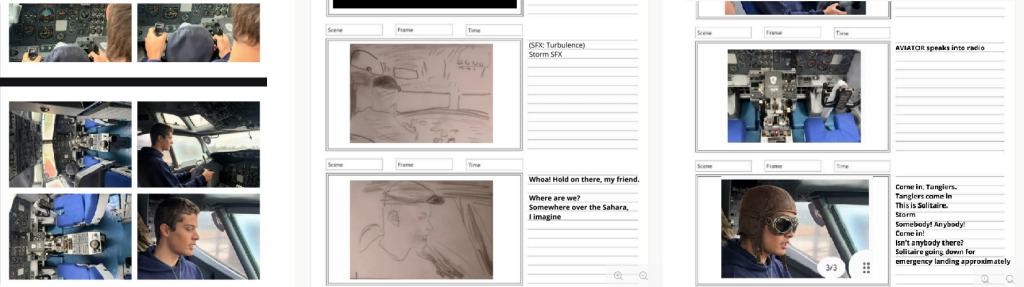
Using this material, we mapped out the project’s different stages and assigned roles for the shoot. Juana A. took on the roles of direction and production, contributing from the planning stage through the selection of framing choices, and working closely with Genaro P., the sequence’s main performer, on the blocking within the space. Violeta C. and Nathalie F. also played key roles as cinematographers, taking responsibility for operating the camera and leading the visual execution of the shoot.
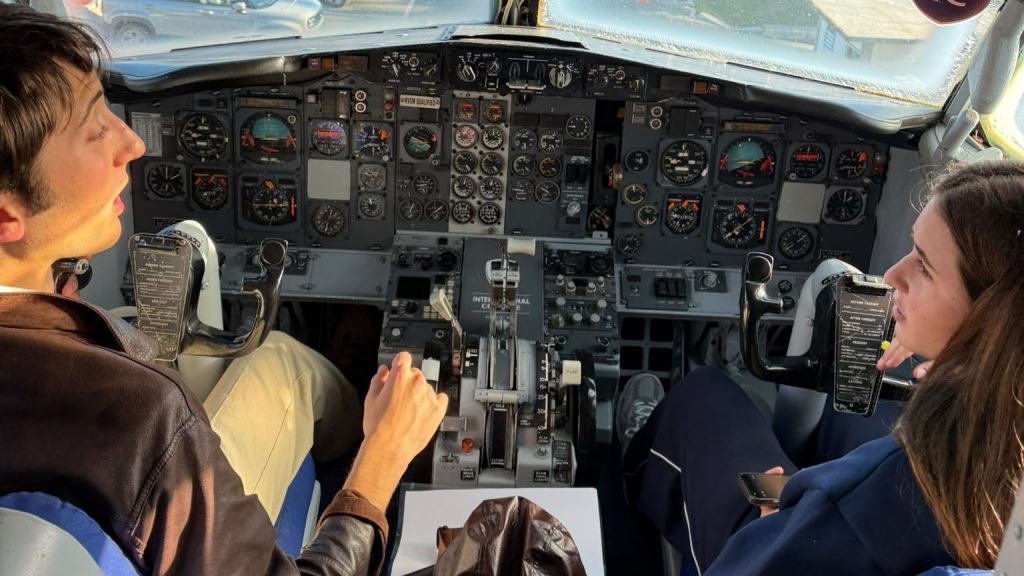
The chosen location was one of the most exciting aspects of the project, but it also presented significant challenges. Filming inside the cockpit of a Boeing meant working in an extremely confined space, with very limited room for the camera, crew and actor. Many of the ideas that seemed feasible on the storyboard had to be reconsidered once we were on location.
It was precisely at this point that the project revealed some of its greatest educational value. The cinematographers had to observe, problem-solve and adapt their plans to the realities of the shooting environment. Their creativity and ability to find practical solutions within these constraints were essential in achieving a highly successful final result.
Another major challenge was time. Coordinating the schedules of the technical team, the students and Genaro required careful planning to complete the shoot within a limited timeframe. This highlighted an important aspect of professional filmmaking that cannot always be replicated in a classroom setting: successful productions depend not only on creative ideas, but also on organisation, communication and the ability to make decisions under real-world constraints.
After filming concluded, the project moved into post-production. As the final piece came together, we reflected on the entire journey, viewing the process as a whole, from the initial concept and script analysis through location scouting, photography, storyboarding and filming to the editing timeline and the finished product.
One of the most significant learning outcomes emerged from this holistic view of the process. Students did not simply receive a completed film or participate in an isolated activity. Instead, they gained an understanding of the entire creative journey and recognised how each stage both shapes and informs the next.
They also experienced the realities of collaborative filmmaking firsthand. They assumed responsibility within different production roles, made creative and practical decisions, addressed unexpected challenges during filming and worked together towards a shared goal.
Projects like this allow many of the concepts explored in the classroom to move beyond theory and become meaningful lived experiences. Pre-production, framing, blocking, cinematography, planning and editing take on a new significance when students are required to apply them to solve real production challenges.
Our collaboration with the IC Theatre Company made precisely this possible: transforming a genuine production need for The Little Prince into a rich and authentic audiovisual learning experience.
Special thanks to Juana A., Violeta C. and Nathalie F. for the commitment, creativity and professionalism they brought to the project, and to the IC Theatre Company team, especially Cristina and Candice, for inviting us to be part of this experience.
Matías Martínez
IB Film Teacher